Demo — End-to-End Worked Example
A complete, runnable, end-to-end example built on the Beginner Template, so you can see exactly what a finished implementation looks like. The plant here is a textbook second-order system, not the aircraft. Once you've worked through this, swap the plant and specs for your chosen sub-option of the Aircraft Attitude Control Agent project and you're done.
The source files live at course-demo/ in the tutorial repo — clone the repo and follow the run instructions below.
What's in the demo
- Plant: \(G(s) = \dfrac{1}{s^2 + 3s + 2}\).
- Controller: \(G_c(s) = K_p + K_i / s\).
- Default spec: settling time \(\le 5\) s, overshoot \(\le 10\,\%\), rise time \(\le 1\) s, zero step ess.
- Backend: SJTU API +
python-controlevaluator + agent loop, with the spec parameterized so the frontend can edit it at runtime. - Frontend: Streamlit (default) and Gradio (alternative). Both ship every UI piece the project page requires:
- description of the plant + controller form
- editable settling-time / overshoot / rise-time targets
- Run agent button
- live iteration log
- final step-response plot rendered as SVG for crisp resolution at any size
- collapsible Show system prompt panel exposing the LLM's reasoning context
backend.py
"""Backend: SJTU client + python-control evaluator + PI agent loop.

Specs are passed in by the frontend so the user can edit them; the system prompt
holds the design intuition and the per-run target values are sent in the first
user message.
"""
import json
import os
import numpy as np
import control as ctrl
from dotenv import load_dotenv
from openai import OpenAI

load_dotenv()

client = OpenAI(
    api_key=os.environ["SJTU_API_KEY"],
    base_url="https://models.sjtu.edu.cn/api/v1",
)
MODEL = "deepseek-chat"


# ---------- Plant: G(s) = 1 / ((s+1)(s+2)) ----------
def build_plant() -> ctrl.TransferFunction:
    return ctrl.TransferFunction([1], [1, 3, 2])


G = build_plant()

DEFAULT_SPECS = {
    "settling_time_max": 5.0,    # seconds (2 % criterion)
    "overshoot_max":     10.0,   # %
    "rise_time_max":     1.0,    # seconds
}


def evaluate(gains: dict, specs: dict) -> dict:
    kp = float(gains.get("kp", 0))
    ki = float(gains.get("ki", 0))
    K = ctrl.TransferFunction([kp, ki], [1, 0])
    T = ctrl.feedback(K * G, 1)
    if not np.all(np.real(ctrl.poles(T)) < 0):
        return {"stable": False, "passes": False, "T": T,
                "settling_time": None, "overshoot": None, "rise_time": None}
    info = ctrl.step_info(T)
    perf = {
        "stable": True,
        "settling_time": float(info["SettlingTime"]),
        "overshoot": float(info["Overshoot"]),
        "rise_time": float(info["RiseTime"]),
        "T": T,
    }
    perf["passes"] = (perf["settling_time"] <= specs["settling_time_max"]
                      and perf["overshoot"]     <= specs["overshoot_max"]
                      and perf["rise_time"]     <= specs["rise_time_max"])
    return perf


def passes(perf: dict) -> bool:
    return bool(perf.get("passes"))


SYSTEM_PROMPT = """You are a control-systems engineer. Design a PI controller
G_c(s) = Kp + Ki/s for the plant G(s) = 1 / ((s+1)(s+2)).

The user will give you specific design targets in the first message; aim to
meet all of them. Step zero-steady-state-error is automatic with PI.

Design intuition:
  - Closed-loop polynomial is s^3 + 3 s^2 + (2 + Kp) s + Ki.
  - The PI zero is at s = -Ki/Kp. Place it near a plant pole (-1 or -2) to
    keep the integral mode FAST. Target Ki/Kp ~ 1-2.
  - Kp speeds the dominant complex pair: small -> slow rise; large -> overshoot.
  - WARNING: if Ki << Kp the integral pole drifts toward s = 0 and settling
    blows up even with no overshoot.

Respond ONLY with JSON {"kp": <number>, "ki": <number>}. No prose."""


def initial_user_msg(specs: dict) -> str:
    return (f"Design targets for this run:\n"
            f"  - settling time <= {specs['settling_time_max']} s\n"
            f"  - overshoot     <= {specs['overshoot_max']} %\n"
            f"  - rise time     <= {specs['rise_time_max']} s\n"
            f"  - zero step steady-state error\n"
            f"Propose initial (Kp, Ki).")


def feedback_msg(i: int, gains: dict, perf: dict, specs: dict) -> str:
    kp, ki = gains["kp"], gains["ki"]
    if not perf["stable"]:
        return f"Iter {i}: Kp={kp}, Ki={ki} is UNSTABLE. Reduce Ki and/or Kp."
    issues = []
    if perf["settling_time"] > specs["settling_time_max"]:
        if perf["overshoot"] < 3.0 and ki < kp:
            issues.append(f"settling={perf['settling_time']:.2f}s with little overshoot — "
                          f"the slow mode is the PI integral pole. INCREASE Ki toward Kp.")
        else:
            issues.append(f"settling={perf['settling_time']:.2f}s > {specs['settling_time_max']}s.")
    if perf["overshoot"] > specs["overshoot_max"]:
        issues.append(f"overshoot={perf['overshoot']:.2f}% > {specs['overshoot_max']}%; "
                      f"REDUCE Kp, keep Ki/Kp similar.")
    if perf["rise_time"] > specs["rise_time_max"]:
        issues.append(f"rise={perf['rise_time']:.3f}s > {specs['rise_time_max']}s; "
                      f"INCREASE Kp (and Ki proportionally).")
    return (f"Iter {i}: Kp={kp}, Ki={ki}. {'; '.join(issues)} "
            f"Hint: keep Ki/Kp around 1-2 so the PI zero stays near the slow plant pole.")


MAX_ITER = 8


def run_agent(specs: dict | None = None):
    """Generator. Yields one dict per iteration; the frontend renders these live."""
    specs = specs if specs is not None else DEFAULT_SPECS
    messages = [
        {"role": "system", "content": SYSTEM_PROMPT},
        {"role": "user", "content": initial_user_msg(specs)},
    ]
    for i in range(1, MAX_ITER + 1):
        resp = client.chat.completions.create(
            model=MODEL, messages=messages,
            response_format={"type": "json_object"}, temperature=0,
        )
        raw = resp.choices[0].message.content
        gains = json.loads(raw)
        perf = evaluate(gains, specs)
        yield {"iter": i, "gains": gains, "perf": perf, "raw": raw, "specs": specs}
        if passes(perf):
            return
        messages.append({"role": "assistant", "content": raw})
        messages.append({"role": "user", "content": feedback_msg(i, gains, perf, specs)})


def step_plot_svg(T, gains: dict, specs: dict) -> str:
    """Render the step response as an SVG string, ready to embed in either UI."""
    import io
    import matplotlib.pyplot as plt
    t = np.linspace(0, 8, 800)
    t_out, y_out = ctrl.step_response(T, T=t)
    fig, ax = plt.subplots(figsize=(7, 4))
    ax.plot(t_out, y_out, lw=2)
    ax.axhline(1.0, ls="--", color="gray", lw=0.8)
    ax.axhline(1.0 + specs["overshoot_max"] / 100, ls=":", color="red", lw=0.7,
               label=f"overshoot spec ({specs['overshoot_max']:.0f} %)")
    ax.axvline(specs["settling_time_max"], ls="--", color="green", lw=0.8,
               label=f"settling spec ({specs['settling_time_max']:.1f} s)")
    ax.set_xlabel("time (s)"); ax.set_ylabel("y(t)")
    ax.set_title(f"Converged step response — Kp={gains['kp']}, Ki={gains['ki']}")
    ax.legend(loc="lower right", fontsize=9); ax.grid(True, alpha=0.3)
    buf = io.StringIO()
    fig.savefig(buf, format="svg", bbox_inches="tight")
    plt.close(fig)
    return buf.getvalue()
app_streamlit.py (default)
"""Streamlit frontend. Run: streamlit run app_streamlit.py"""
import streamlit as st

from backend import (DEFAULT_SPECS, MAX_ITER, SYSTEM_PROMPT,
                     passes, run_agent, step_plot_svg)

st.set_page_config(page_title="Course Project Demo", layout="wide")
st.title("Course Project Demo")

st.markdown(r"""
**Plant**: $G(s) = \dfrac{1}{(s+1)(s+2)}$ — two real poles at $s = -1, -2$.

**Controller**: PI, $G_c(s) = K_p + K_i / s$.

**Goal**: design $K_p$ and $K_i$ so the unit-feedback closed-loop step response
hits the targets below. An LLM agent proposes gains, a `python-control`
evaluator scores them, and the loop iterates until every spec passes.
""")

st.subheader("Design targets")
col1, col2, col3 = st.columns(3)
with col1:
    settling_max = st.number_input("Settling time max (s)",
                                   value=DEFAULT_SPECS["settling_time_max"],
                                   min_value=0.1, step=0.5, format="%.2f")
with col2:
    overshoot_max = st.number_input("Overshoot max (%)",
                                    value=DEFAULT_SPECS["overshoot_max"],
                                    min_value=0.0, step=1.0, format="%.2f")
with col3:
    rise_max = st.number_input("Rise time max (s)",
                               value=DEFAULT_SPECS["rise_time_max"],
                               min_value=0.05, step=0.1, format="%.2f")

specs = {"settling_time_max": float(settling_max),
         "overshoot_max":     float(overshoot_max),
         "rise_time_max":     float(rise_max)}

with st.expander("Show system prompt (LLM reasoning context)"):
    st.code(SYSTEM_PROMPT, language="text")

if st.button("Run agent", type="primary"):
    log_placeholder = st.empty()
    log_lines, converged_step = [], None
    for step in run_agent(specs):
        i, g, p = step["iter"], step["gains"], step["perf"]
        log_lines.append(f"Iter {i}: Kp={g['kp']}, Ki={g['ki']} → "
                         f"settling={p['settling_time']!s:<8s} ovr={p['overshoot']!s:<7s} "
                         f"rise={p['rise_time']!s:<8s} pass={p['passes']}")
        log_placeholder.code("\n".join(log_lines))
        if passes(p):
            converged_step = step
            st.success(f"Converged at iteration {i}.")
            break
    if converged_step is None:
        st.error(f"Did not converge within {MAX_ITER} iterations.")
    else:
        svg = step_plot_svg(converged_step["perf"]["T"],
                            converged_step["gains"], specs)
        st.markdown(f'<div style="max-width:760px;margin:auto">{svg}</div>',
                    unsafe_allow_html=True)
app_gradio.py (alternative)
"""Gradio frontend. Run: python app_gradio.py"""
import gradio as gr

from backend import (DEFAULT_SPECS, MAX_ITER, SYSTEM_PROMPT,
                     passes, run_agent, step_plot_svg)


def run_with_specs(settling_max, overshoot_max, rise_max):
    specs = {"settling_time_max": float(settling_max),
             "overshoot_max":     float(overshoot_max),
             "rise_time_max":     float(rise_max)}
    log, final_svg = [], ""
    for step in run_agent(specs):
        i, g, p = step["iter"], step["gains"], step["perf"]
        log.append(f"Iter {i}: Kp={g['kp']}, Ki={g['ki']} → "
                   f"settling={p['settling_time']!s:<8s} ovr={p['overshoot']!s:<7s} "
                   f"rise={p['rise_time']!s:<8s} pass={p['passes']}")
        if passes(p):
            log.append(f"\nConverged at iteration {i}.")
            final_svg = (f'<div style="max-width:760px;margin:auto">'
                         f'{step_plot_svg(p["T"], g, specs)}</div>')
            break
    else:
        log.append(f"\nDid not converge within {MAX_ITER} iterations.")
    return "\n".join(log), final_svg


with gr.Blocks(title="Course Project Demo") as iface:
    gr.Markdown("# Course Project Demo")
    gr.Markdown(
        r"""
**Plant**: $G(s) = \dfrac{1}{(s+1)(s+2)}$ — two real poles at $s = -1, -2$.

**Controller**: PI, $G_c(s) = K_p + K_i / s$.

**Goal**: design $K_p$ and $K_i$ so the unit-feedback closed-loop step response
hits the targets below. An LLM agent proposes gains, a `python-control`
evaluator scores them, and the loop iterates until every spec passes.
""",
        latex_delimiters=[{"left": "$", "right": "$", "display": False}],
    )

    gr.Markdown("### Design targets")
    with gr.Row():
        settling_in = gr.Number(label="Settling time max (s)",
                                value=DEFAULT_SPECS["settling_time_max"])
        overshoot_in = gr.Number(label="Overshoot max (%)",
                                 value=DEFAULT_SPECS["overshoot_max"])
        rise_in = gr.Number(label="Rise time max (s)",
                            value=DEFAULT_SPECS["rise_time_max"])

    with gr.Accordion("Show system prompt (LLM reasoning context)", open=False):
        gr.Textbox(value=SYSTEM_PROMPT, lines=18, interactive=False, show_label=False)

    run_btn = gr.Button("Run agent", variant="primary")
    log_out = gr.Textbox(label="Iteration log", lines=12)
    plot_out = gr.HTML(label="Step response")

    run_btn.click(fn=run_with_specs,
                  inputs=[settling_in, overshoot_in, rise_in],
                  outputs=[log_out, plot_out])


if __name__ == "__main__":
    iface.launch()
What converges
A real run against SJTU deepseek-chat (default targets, 2026-05-05):
Iter 1: Kp=3.0, Ki=2.5 → settling=3.04 s  ovr=4.86 %  rise=1.11 s  pass=False
Iter 2: Kp=4.0, Ki=3.5 → settling=3.84 s  ovr=11.90 % rise=0.92 s  pass=False
Iter 3: Kp=3.5, Ki=3.0 → settling=2.95 s  ovr=8.59 %  rise=0.96 s  pass=True
The trajectory is the typical PI-tuning two-step:
- Iter 1 — first guess sits in the right neighborhood, but rise time misses (1.11 s vs 1 s spec). The feedback says "increase Kp to speed it up".
- Iter 2 — model bumps Kp from 3 → 4. Rise time now passes, but the closed loop is now too underdamped — overshoot jumps to 11.9 % and breaks the spec. Feedback says "reduce Kp, keep Ki/Kp similar".
- Iter 3 — model bisects to Kp = 3.5, Ki = 3.0. All three time-domain specs pass.
Converged step response:
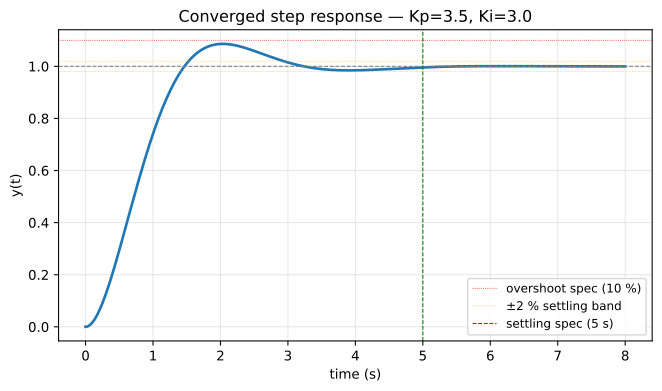
Three iterations, three API calls, three evaluator runs. The agent loop is doing exactly what a human would do at the controls bench, just faster. Tighten the targets in the spec block and the convergence path changes — try it.
Run it
Clone the repo and run from the course-demo/ folder:
git clone https://github.com/MarkJH2001/LLM-Control-Tutorial.git
cd LLM-Control-Tutorial/course-demo

python -m venv venv
source venv/bin/activate                    # macOS / Linux
# venv\Scripts\activate                      # Windows

pip install -r requirements.txt
cp .env.example .env                         # then edit .env: SJTU_API_KEY=sk-...

streamlit run app_streamlit.py               # default — opens http://localhost:8501
# or:
python app_gradio.py                          # alternative — opens http://127.0.0.1:7860
Click Run agent (Streamlit) or Submit (Gradio) and watch the iteration log fill in. SJTU API access requires the campus network or VPN.
How to adapt this for the aircraft project
The demo is a template, not the answer. To turn it into your real submission:
- Replace
build_plant()with the aircraft attitude-control plant from Figure 2 of the project page. Compute the open-loop \(G(s)\) once symbolically (paper orsympy) and hard-code its numerator and denominator coefficients. - Replace
DEFAULT_SPECSwith the targets for whichever sub-option (a)–(d) you picked. Add aness_accel_maxentry for (b)–(d) and aness_ramp_maxfor (a). - Extend
evaluate()with the steady-state-error computation for your sub-option (use the velocity / acceleration error constants \(K_v, K_a\) from the open-loop transfer function). - Rewrite
SYSTEM_PROMPTandfeedback_msgwith the design intuition specific to the aircraft plant — what each gain does on a third-order plant, how the inner motor loop interacts with PI, etc. (See the "Where your control-theory knowledge goes" section on the project page.) - For sub-option (d), swap the time-domain
step_infochecks for frequency-domainmarginandbandwidth; render Bode instead of step response instep_plot_svg.
Everything else — the SJTU client, the agent loop, the spec-input widgets, the SVG rendering — stays the same.