PID Tuning


Every controls student learns the difference between open-loop and closed-loop control on day one: without a sensor reading the output, a controller can only hope its command produced the right result; with a sensor closing the loop, the controller can measure the error and correct. That exact distinction applies to LLM workflows. A single chat turn is open-loop — you ask, the model answers, you find out later whether it was right. An agent with a deterministic evaluator in the loop is closed-loop — the model's proposal is measured against the spec and the result feeds back into the next turn.
flowchart LR
    subgraph A [Open-loop chat]
        direction LR
        U1[User spec] --> L1[LLM reasoning]
        L1 --> P1[Proposed action]
        P1 --> H1[Hope]
    end
    subgraph B [Closed-loop agent]
        direction LR
        U2[User spec] --> L2[LLM reasoning]
        L2 --> P2[Proposed action]
        P2 --> E[Evaluator]
        E -->|metrics + feedback| L2
        E --> H2[Verified]
    end
This page turns that analogy into code. Same plant, same spec, same model — run once open-loop, run once with the evaluator in the loop, compare.
The problem
Design a PI controller \(K(s) = K_p + K_i/s\) for the first-order plant
so that the closed-loop step response meets:
- settling time ≤ 1 second (2 % criterion)
- overshoot ≤ 5 %
- zero steady-state error (the integral term handles this automatically when the loop is stable)
The evaluator
Deterministic, python-control-backed. Given a candidate \((K_p, K_i)\), it builds the closed loop, checks stability, and reads settling time and overshoot off the step response.
import numpy as np
import control as ctrl

SPECS = {"settling_time_max": 1.0, "overshoot_max": 5.0}


def evaluate_pi(kp: float, ki: float) -> dict:
    G = ctrl.TransferFunction([1], [1, 1])
    K = ctrl.TransferFunction([kp, ki], [1, 0])
    T = ctrl.feedback(K * G, 1)
    poles = ctrl.poles(T)
    stable = bool(np.all(np.real(poles) < 0))
    if not stable:
        return {"stable": False, "settling_time": None, "overshoot": None}
    info = ctrl.step_info(T)
    return {
        "stable": True,
        "settling_time": float(info["SettlingTime"]),
        "overshoot": float(info["Overshoot"]),
    }


def passes(perf: dict) -> bool:
    return (perf["stable"]
            and perf["settling_time"] <= SPECS["settling_time_max"]
            and perf["overshoot"] <= SPECS["overshoot_max"])
The evaluator is the sensor. The loop that pipes it back to the LLM is what makes the workflow closed-loop.
Run A — open-loop chat
One LLM call. The model proposes \((K_p, K_i)\) in JSON; we parse and evaluate. No feedback path.
SYSTEM_PROMPT = """You are a control-systems engineer. You are given a first-order plant
G(s) = 1 / (s + 1) and must design a PI controller K(s) = Kp + Ki/s that drives the
closed-loop step response to meet:

  - settling time <= 1 second (2% criterion)
  - overshoot <= 5%
  - zero steady-state error

Respond ONLY with JSON of the form {"kp": <number>, "ki": <number>}. No prose."""


resp = client.chat.completions.create(
    model=model,
    messages=[
        {"role": "system", "content": SYSTEM_PROMPT},
        {"role": "user",   "content": "Propose (Kp, Ki)."},
    ],
    response_format={"type": "json_object"},
    temperature=0,
)
kp, ki = json.loads(resp.choices[0].message.content).values()
perf = evaluate_pi(kp, ki)
print(f"Kp={kp}, Ki={ki} → {perf}, pass={passes(perf)}")
On qwen-plus (2026-04-21):
LLM proposed:    Kp=3.5, Ki=3.0
Evaluator says:  stable=True, settling=1.609 s, overshoot=0.00%
Specs met?       False
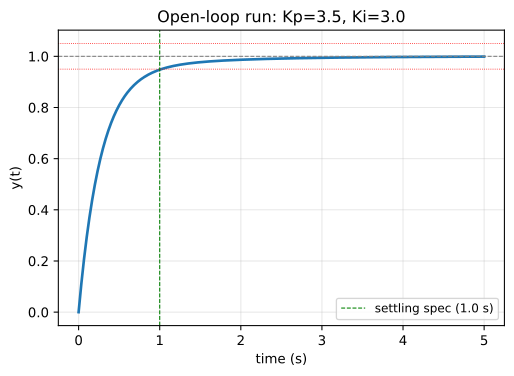
The proposal is stable and has no overshoot — reasonable engineering intuition for a first try — but the settling time is 1.6 s against a 1 s spec, so the design fails. Critically, a chat-style workflow has no way to know this. You only find out because we ran the evaluator after the fact. Inside the chat, the model has already handed you its answer and walked away.
Run B — closed-loop agent
Same system prompt, same first proposal. The difference is the loop. After each attempt, the evaluator's verdict is fed back as a new user message, and the model reads it before proposing again.
def feedback_msg(iter_num, kp, ki, perf):
    if not perf["stable"]:
        return f"Iteration {iter_num}: Kp={kp}, Ki={ki} is UNSTABLE. Propose new (Kp, Ki)."
    issues = []
    if perf["settling_time"] > SPECS["settling_time_max"]:
        issues.append(f"settling time {perf['settling_time']:.3f} s exceeds spec {SPECS['settling_time_max']} s")
    if perf["overshoot"] > SPECS["overshoot_max"]:
        issues.append(f"overshoot {perf['overshoot']:.2f}% exceeds spec {SPECS['overshoot_max']}%")
    return f"Iteration {iter_num}: Kp={kp}, Ki={ki} failed — {'; '.join(issues)}. Propose new (Kp, Ki) to fix this."


messages = [
    {"role": "system", "content": SYSTEM_PROMPT},
    {"role": "user",   "content": "Propose (Kp, Ki)."},
]

for i in range(1, 9):  # max 8 iterations
    resp = client.chat.completions.create(
        model=model, messages=messages,
        response_format={"type": "json_object"}, temperature=0,
    )
    raw = resp.choices[0].message.content
    kp, ki = json.loads(raw).values()
    perf = evaluate_pi(kp, ki)
    if passes(perf):
        break
    messages.append({"role": "assistant", "content": raw})
    messages.append({"role": "user",      "content": feedback_msg(i, kp, ki, perf)})
On qwen-plus (2026-04-21):
| Iter | \(K_p\) | \(K_i\) | Stable | Settling (s) | Overshoot (%) | Passes? |
|---|---|---|---|---|---|---|
| 1 | 3.5 | 3.0 | ✓ | 1.609 | 0.00 | ✗ |
| 2 | 6.0 | 5.0 | ✓ | 0.935 | 0.00 | ✓ |
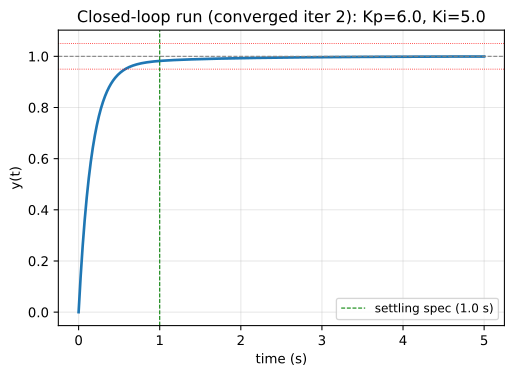
Iteration 1 is the same proposal as Run A — same failure. In iteration 2 the model reads "settling time 1.609 s exceeds spec 1 s", approximately doubles \(K_p\) and bumps \(K_i\) to match, and the new design passes. Two rounds, one evaluator call per round.
Why this is the same shape as closed-loop control
Read the two mermaid diagrams again with a single mental substitution — replace "LLM reasoning" with "controller", "evaluator" with "sensor", and "proposed action" with "control signal". You get the block diagrams from week one of every controls course. The engineering instinct that tells you "you can't hit a spec without feedback" applies unchanged to LLM workflows: without a deterministic measurement fed back into the next turn, you're doing open-loop guessing. With one — however lightweight — you have a closed loop that can correct.
The evaluator doesn't need to be sophisticated. Here it's ten lines of python-control. What matters is that it's deterministic and it feeds its verdict back into the next model call.
Extending to other plants
The demo above uses a first-order stable plant, but the same agent pattern generalizes. The ControlAgent paper that this page is modelled on dispatches to six specialized sub-agents based on plant class:
| Plant class | Form | Notes |
|---|---|---|
| First-order stable | \(G(s) = K/(\tau s + 1)\) | Covered in code above. |
| First-order unstable | \(G(s) = K/(\tau s - 1)\) | Right-half-plane pole; the controller must first stabilize. |
| First-order with delay | \(G(s) = K e^{-Ts}/(\tau s + 1)\) | Needs a Padé approximation inside the evaluator. |
| Second-order stable | \(G(s) = K/(s^2 + 2\zeta\omega_n s + \omega_n^2)\) | Underdamped cases where overshoot is the real constraint. |
| Second-order unstable | \(G(s) = K/(s^2 - as + b)\) | Combines stabilization and performance tuning. |
| Higher-order | Multi-pole / zero | Design memory matters — past iterations keep the agent from looping on bad regions. |
A central agent reads the user's plant and routes to the matching sub-agent. Each sub-agent runs the same propose → evaluate → feedback loop, just with the evaluator and the prompt specialised for its plant class. We keep this page's code to the first-order stable case so the core pattern stays clear; scaling out is a matter of adding sub-agents, not changing the shape of the loop.
Takeaways
- Chat is open-loop, agent is closed-loop. The analogy isn't decoration — it's the whole argument for building agents instead of just prompting.
- The evaluator is the sensor. It can be a ten-line function and still turn a hopeful guess into a verified result.
- Sub-agents scale, the loop doesn't change. Different plant classes need different evaluators and different expert prompts; they don't need a different workflow shape.
Next
Back to the LLM + Control overview, or forward to Real-World Applications.